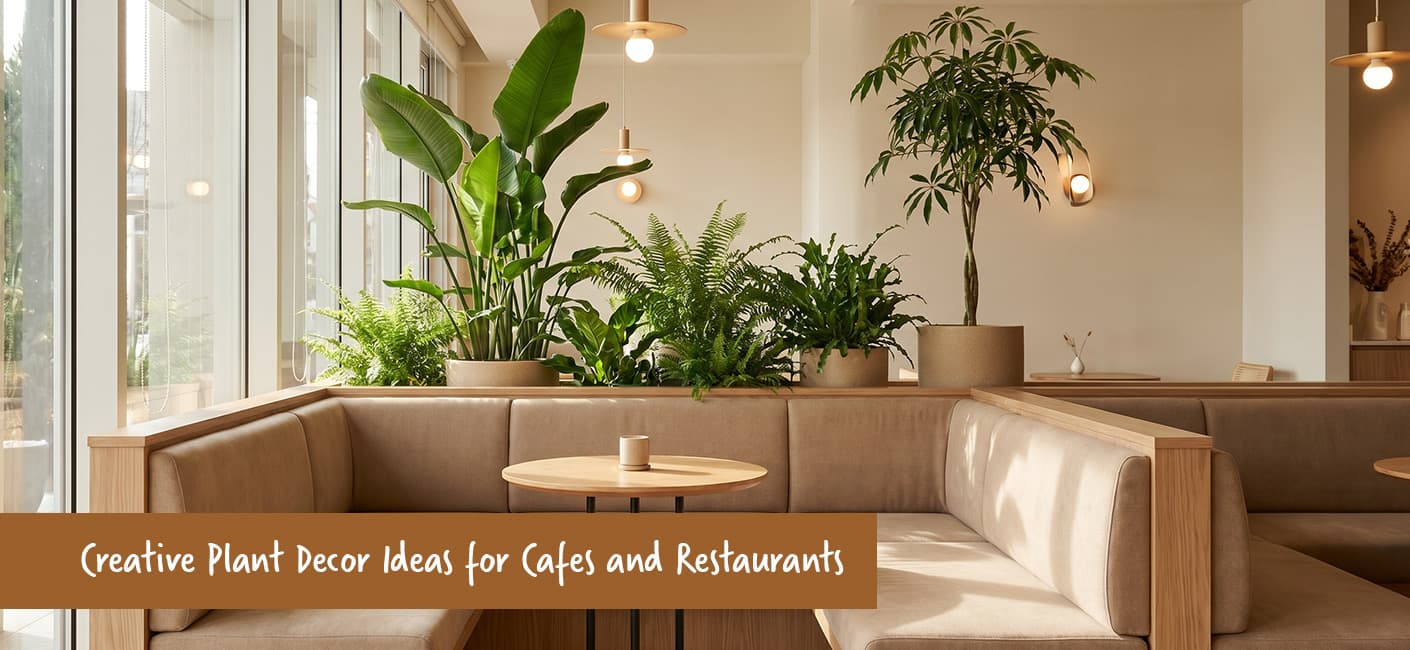
9 Creative Plant Decor Ideas for Cafes and Restaurants
1. Start with a Statement Entrance
First impressions matter.
Before guests even look at the menu, they begin forming an opinion about your establishment. A thoughtfully designed entrance lined with greenery instantly creates a welcoming experience.
For larger entrances, consider tall plants such as Areca Palms, Bamboo Palms, or Dracaena. Pair them with elegant planters like Telon to create a sophisticated arrival experience.
For wider entrances or outdoor seating areas, Aldero MR can be used to create structured green borders that naturally guide visitors into the space.
2. Create Instagram Worthy Green Corners

Let’s be honest. Guests love taking photos.
A well-designed green corner can become one of the most photographed spots in your café or restaurant.
Instead of filling the area with multiple decorative items, let the plants do the talking. Combine a statement plant such as a Monstera or Fiddle Leaf Fig with sculptural designer pots that complement your interior theme.
Cacto works particularly well here. Its artistic bulbous shape naturally draws attention and turns even a simple plant arrangement into a design feature.
3. Use Plants to Divide Spaces Naturally
Not every partition needs to be a wall.
Open dining layouts often benefit from subtle separation between seating zones. Planters can create privacy while maintaining openness and visual flow.
The Rezelo collection from Bonasila is ideal for this purpose. Whether you’re separating dining sections, creating outdoor boundaries, or defining waiting areas, they provide structure without making the space feel confined.
Guests appreciate the sense of intimacy, while designers appreciate the flexibility.
4. Add Life to Empty Corners
Every café has them.
That awkward corner near the window. The unused space beside a counter. The area near the staircase that feels incomplete.
Plants are often the simplest solution.
Tall species like Rubber Plants, Kentia Palms, and Bird of Paradise plants can fill vertical space beautifully.
Pair them with Belios MS or with Bucciro for a grand, premium appearance that instantly makes the corner feel intentional.
5. Bring Nature to Tabletops
Not every plant display needs to be large.
Smaller arrangements can make dining experiences feel warmer and more personal.
Compact plants such as Pothos, Peace Lilies, and small Ferns work beautifully on communal tables, reception counters, and window ledges.
For these settings, Altami offers the perfect balance of simplicity and sophistication. Its rounded form adds softness without competing with the rest of the décor.
6. Design a Relaxing Outdoor Dining Area
Outdoor seating continues to be one of the most sought-after features in hospitality spaces.
The challenge is making these areas feel cohesive and comfortable.
Layering plants of varying heights can help create depth and enclosure. Tall planters establish structure, while bowl-shaped arrangements introduce softness closer to the ground.
Tagaro works particularly well in outdoor café settings. Its wide bowl-like profile creates a relaxed, organic aesthetic that blends naturally into patios, courtyards, and garden dining spaces.
7. Match Planters with Your Personality
One of the most overlooked design opportunities is selecting planters that reflect the personality of your café or restaurant.
Ask yourself:
- Is your brand minimalist and contemporary?
- Warm and rustic?
- Luxurious and upscale?
- Artistic and unconventional?
For modern interiors, Zefo and Bucciro offer clean, refined silhouettes.
For artistic spaces, Cacto and Marlos introduce character and visual intrigue.
For timeless settings, Orino delivers a familiar elegance that never feels out of place.
The right planter doesn’t just hold a plant. It becomes part of your brand story.
8. Don’t Forget the Waiting Area
Waiting areas are often underutilized from a design perspective. Yet they are where guests spend time observing their surroundings.
A thoughtfully placed arrangement featuring a statement planter can make waiting feel more pleasant and contribute to the overall experience.
A combination of Corin with a lush foliage plant or Molli with a structured indoor tree can instantly elevate these transitional spaces.
9. A Simple Rule: Less Can Be More
One common mistake is trying to add plants everywhere.The most successful hospitality interiors use greenery strategically.
A few carefully selected plants in beautifully crafted designer pots often create a stronger impact than dozens of smaller arrangements scattered throughout the space.
Give each plant room to breathe. Allow statement pieces to stand out. Let empty space play its role in the overall composition.
Why FRP Planters Work So Well for Cafes and Restaurants
Hospitality environments demand more from planters than residential spaces.
They need to be durable, easy to maintain, lightweight enough for repositioning, and visually appealing year after year.
That’s why many designers and business owners prefer FRP planters. Bonasila’s collection combines durability with design flexibility, making it easier to create interiors and outdoor environments that feel polished, welcoming, and memorable.
Whether you’re designing a boutique café, a rooftop restaurant, a fine dining destination, or a casual eatery, the right planter can play a surprisingly important role in shaping the guest experience.
FAQs
Q1. Why are plants important in cafés and restaurants?
Ans. Plants create a welcoming atmosphere, enhance aesthetics, and make hospitality spaces feel more inviting and comfortable.
Q2. Which plants work best for cafés and restaurants?
Ans. Monstera, Areca Palm, Rubber Plant, Peace Lily, Bamboo Palm, and Fiddle Leaf Fig are popular choices for hospitality spaces.
Q3. How can designer pots improve restaurant interiors?
Ans. Designer pots elevate the presentation of plants, helping them become intentional design elements rather than simple decorative additions.
Q4. Which Bonasila planters are best for hospitality spaces?
Ans. Telon, Cacto, Aldero MR, Tagaro, Zefo, and Belios MS are excellent choices depending on the space and design requirements.
Q5. Why are FRP planters suitable for cafés and restaurants?
Ans. FRP planters are lightweight, durable, weather-resistant, and easy to maintain, making them ideal for high-traffic hospitality environments.