
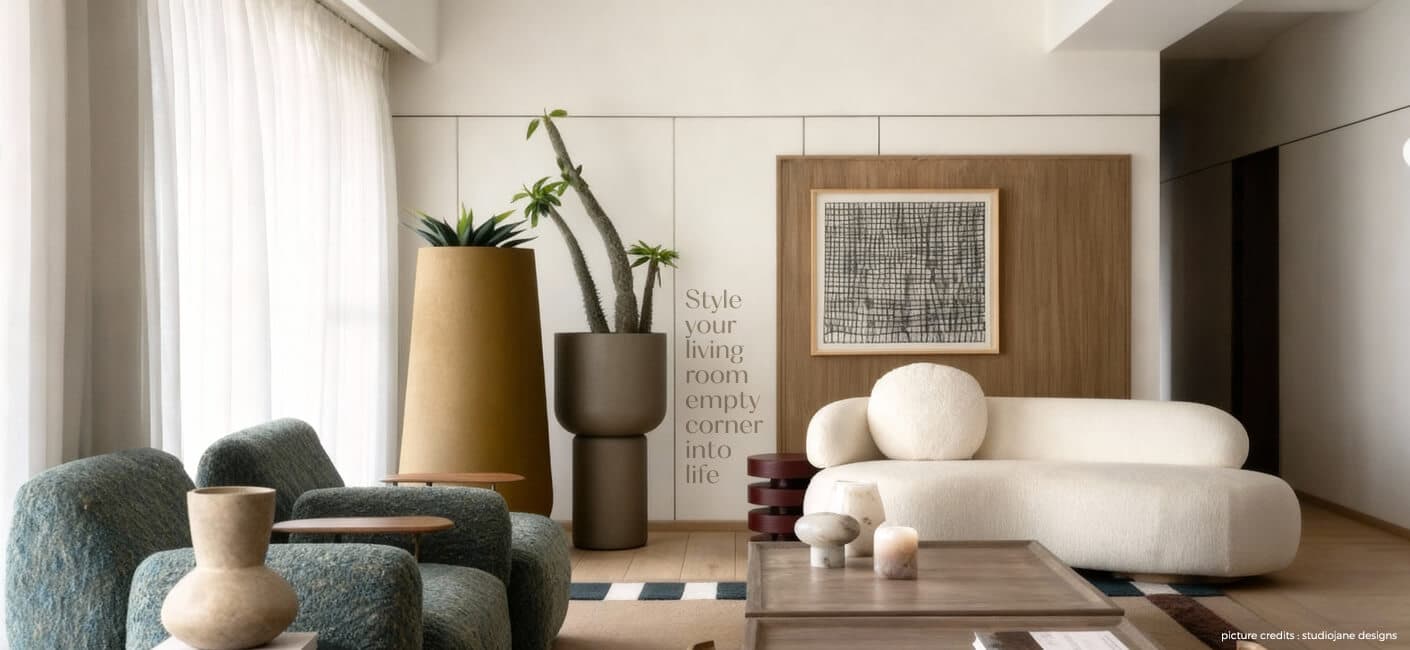
Ideas to Style your Living Room Corner
1. Let a Statement Indoor Plant Take the Lead
A tall indoor plant instantly changes the energy of a corner. It softens rigid lines, adds vertical movement, and introduces calm.
Plants like fiddle leaf fig, rubber plant, or areca palm work beautifully because they have strong structure without feeling heavy.
Placement tip:
Keep the plant slightly angled toward the room instead of pushing it flat against the wall. This creates flow and prevents the corner from feeling boxed in.
Planter pairing – Cilita:

Pair your plant with Cilita, a designer planter inspired by traditional flower pots. Its graceful curves and vibrant colour options add warmth while keeping the look refined.
Cilita 14 works well for living rooms, while Cilita 20 or 27 make excellent indoor planters for corners and entry-adjacent spaces. The result feels grounded, elegant, and effortlessly styled.
2. Create a Calm Reading Nook
A quiet corner can become your favourite spot with just a chair, a soft throw, and a plant. This setup works especially well in compact living rooms where every element needs purpose.
Placement tip:
Position the chair at a slight diagonal and place the planter beside it to soften the silhouette. Avoid symmetry – it should feel relaxed, not rigid.
Choose a medium-height plant in a designer planter that complements your upholstery tones. The greenery adds life without stealing attention from the seating.
3. Layer Heights for Visual Depth
Corners feel more alive when they have layers. Instead of relying on a single tall element, combine varying heights; a floor plant, a small stool, and a tabletop planter.
Placement tip:
Use the tallest plant at the back, medium-height décor slightly forward, and the smallest element closest to the room. This creates depth without clutter.
Low-profile indoor planters work especially well here, allowing foliage to spread gently rather than dominate the space.
4. Use the Corner to Display Personality
Corners are perfect for personal expression, whether it’s a sculptural planter, a favourite plant, or a meaningful object. Instead of hiding personality in shelves, let it breathe in an open corner.
Placement tip:
Keep one hero element and build around it subtly. Too many objects compete and dilute impact.
A thoughtfully chosen designer planter with clean lines or soft curves can act as both décor and plant holder, making the corner feel curated rather than decorative.
5. Soften Sharp Architecture with Curves
If your living room has strong lines; boxy furniture, straight walls, or sharp edges – corners are the ideal place to introduce softness. Rounded planters and flowing foliage visually balance the space.
Placement tip:
Choose plants with gentle leaf movement and pair them with rounded indoor planters to break rigidity.
Curved planters like Cilita help soften modern interiors without disrupting their clean aesthetic, making the space feel warmer and more welcoming.
6. Turn an Empty Corner into a Green Pause
Not every corner needs furniture. Sometimes, a single well-placed plant in a refined planter is enough. This works beautifully in minimal or open-plan homes.
Placement tip:
Give the plant breathing room. Avoid crowding it with accessories, negative space enhances its presence.
A well-designed designer planter ensures the corner looks intentional, not unfinished.
7. Balance Light with Greenery
Corners near windows often get overlooked, even though they receive excellent indirect light. This makes them ideal for plants that enjoy brightness without harsh sun.
Placement tip:
Keep plants slightly off-centre to avoid blocking light flow. Rotate occasionally for even growth.
Use indoor planters that reflect or complement your interior colour palette to keep the look cohesive throughout the room.
8. Extend the Living Room’s Design Language
Your corner should feel like part of the room, not an afterthought. Repeat shapes, colours, or finishes already present in your living room through planters and plant selection.
Placement tip:
If your furniture is warm-toned, opt for earthy or muted planter finishes. If your space is modern, stick to clean silhouettes.
A designer planter helps bridge décor elements, making greenery feel integrated rather than added later.
Conclusion: A Corner That Feels Alive
Styling and choosing perfect planter for living room corner is not about filling space. It’s about giving the room a pause, a breath, and a sense of balance.
A thoughtfully chosen plant, paired with the right planter, can soften architecture, elevate mood, and quietly complete the space.
When corners are styled with intention – through scale, form, and natural elements. They stop being forgotten edges and start becoming moments. Moments where the room feels calmer. Warmer. More lived in.
Whether it’s a tall plant anchoring the space, a layered green composition, or a single sculptural planter standing confidently on its own, the right choices can transform even the smallest corner into something meaningful.
Because good design doesn’t shout. It simply feels right.
FAQs
Q1. How many plants should I place in one corner?
One to two plants are ideal. More than that can feel cluttered unless styled with intentional layering.
Q2. Are large planters suitable for living rooms?
Yes, as long as they’re proportionate. Medium to large designer planters anchor corners beautifully without overwhelming the space.
Q3. Can traditional-inspired planters work in modern homes?
Absolutely. Designs like Cilita balance classic curves with modern finishes, making them versatile across styles.
Q4. Should indoor planters match the furniture?
They don’t need to match exactly, complementary tones and shapes work better than perfect matches.

